Email Marketing for Small Businesses: My Journey from Beginner to Professional
I used to hear people talk about email marketing all the time.
Whenever marketers discussed digital marketing, they always mentioned email marketing. Honestly, I never really understood what it meant. I knew emails existed, but I didn’t know businesses could use them to generate leads, build relationships, and increase sales.
Everything changed in 2022. That year became the beginning of my journey into Email Marketing for Small Businesses, and today it has become one of the most valuable digital marketing skills I have.
My First Email Marketing Experience
In 2022, I joined a company that sold software solutions to small and medium-sized businesses (SMEs).
One of my first assignments was simple. “Go online and collect business email addresses.” That was all I did for days.
I searched online, visited company websites, and kept compiling email addresses into an Excel spreadsheet. I honestly thought I was just gathering data.
One day, my boss walked over to my desk and said, “Today we’re going to use that email list.”
That was the first time I heard about LepoPhau.
He showed me how to create an account, convert my Excel spreadsheet into a CSV file, and upload the contacts.
Unfortunately, more than half of the email addresses were invalid. Instead of getting upset, he simply smiled.
Then he said, “Let me give you a quality email list.”
That moment taught me one of the biggest lessons in Email Marketing for Small Businesses.
A small, quality email list is always better than a large list filled with invalid contacts.
Discovering Mailchimp for the First Time
After introducing me to LepoPhau, my boss introduced me to another platform that completely changed how I viewed email marketing.
Mailchimp. Again, I had never heard of it before. He patiently showed me how to:
- Create a Mailchimp account
- Import contacts
- Organize subscribers
- Design professional email campaigns
- Send test emails
- Launch campaigns
At the time, Mailchimp allowed up to 2,000 contacts on its free plan, which made it perfect for small businesses just getting started.
That day, I didn’t just learn software.
I learned that businesses could communicate with hundreds or even thousands of customers at once without making a single phone call.
After that experience, I became responsible for designing email campaigns for different software products our company was promoting.
Every campaign taught me something new.
Learning More Than Just Mailchimp
As time went on, I also learned how to use Zoho Mail. That was when I realized email marketing wasn’t just about sending newsletters.
It involved creating professional business emails, communicating with customers, and building trust.
Even then, I still couldn’t fully explain what email marketing really was. I knew how to do the work, but I didn’t fully understand the strategy behind it.
That understanding came later.
The Digital Marketing Course That Changed Everything
Eventually, I enrolled in a comprehensive digital marketing course.
That course connected all the missing pieces. For the first time, I understood that Email Marketing for Small Businesses isn’t simply about sending emails. It’s about building relationships. It’s about earning trust.
It’s about staying connected with customers long after they leave your website.
During the training, I learned how to:
- Create professional domain email addresses using cPanel
- Connect domain emails to WordPress websites
- Install and configure WPForms
- Collect customer inquiries through contact forms
- Build email lists legally
- Set up SMTP to connect domain emails with Gmail
- Improve email delivery rates
One of my favorite discoveries was SMTP.
Being able to send emails from my business domain directly through Gmail created a much more professional workflow than I had imagined.
It remains one of the most useful email marketing skills I’ve learned.
Building Email Lists the Right Way
One lesson completely changed how I approached marketing.
Your website shouldn’t just attract visitors. It should convert visitors into subscribers.
Whenever someone fills out your contact form, they’re giving you an opportunity to build a relationship. That’s why I began using WPForms on my websites. Instead of simply answering customer questions, I also focused on growing my email list.
Over time, those subscribers became one of my most valuable marketing assets.
How I Built My Email List Throughout My Career
As my experience grew, I became intentional about collecting email addresses ethically.
I remember attending an online training with hundreds of participants.
I had permission to access the participant list, and instead of letting those contacts disappear after the training, I encouraged interested participants to subscribe to receive future updates. Those who agreed became part of my growing email community.
I later added subscribers to both Mailchimp and Brevo to market products from my eCommerce store, KendrisAssortment.store.
Of course, not everyone stayed. Some subscribers unsubscribed. And that’s completely normal.
One lesson every small business should understand is this: An unsubscribe isn’t a failure.
It simply means your audience is becoming more refined. The people who remain are the ones genuinely interested in what you offer.
Email Marketing in My Professional Career
Today, email marketing has become one of my strongest marketing channels.
In my current role as a digital marketer, I work with existing customers who have previously done business with the company.
Rather than constantly searching for new customers, I leverage our existing client database to introduce additional products and services that are relevant to them.
This strategy has consistently produced better engagement because the audience already knows and trusts the company.
The most important principle I follow is confidentiality. Customer information is valuable. Email lists should never be shared, sold, or misused.
When people trust you with their email address, they’re trusting you with direct access to their inbox. That trust should always be respected.
What Is Email Marketing for Small Businesses?
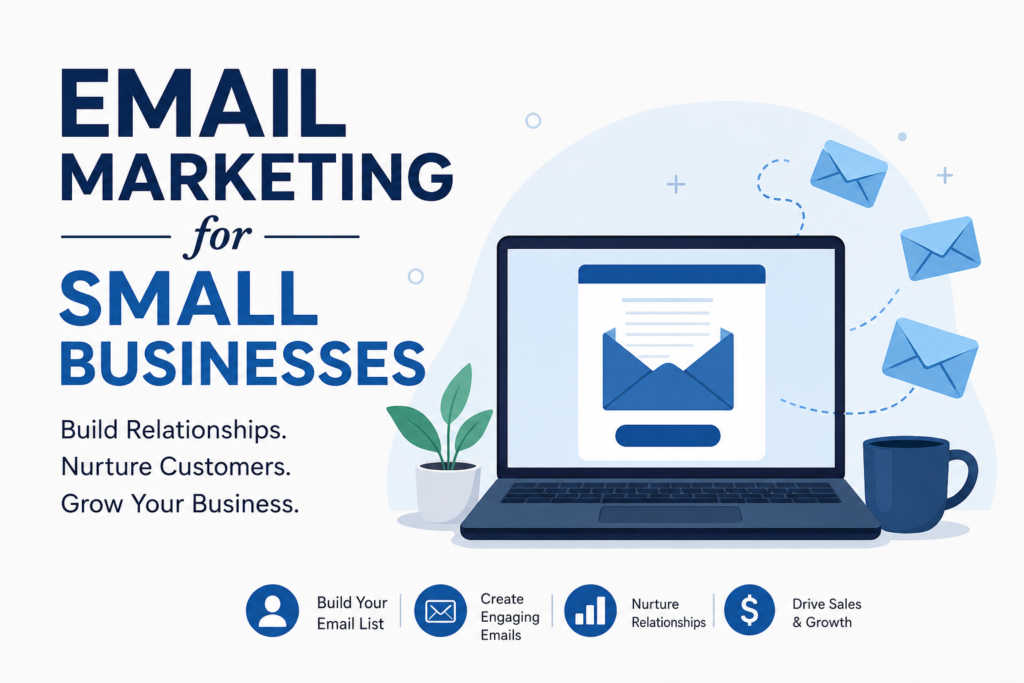
Simply put, Email Marketing for Small Businesses is the process of using email to build relationships with customers, promote products or services, educate subscribers, and increase sales.
Unlike social media, where algorithms decide who sees your content, email gives you direct access to your audience.
When done correctly, it helps businesses:
- Build trust with customers
- Generate qualified leads
- Increase repeat purchases
- Promote new products and services
- Share valuable educational content
- Strengthen customer relationships
- Improve customer retention
- Increase revenue with minimal marketing costs
The Best Email Marketing Tools for Small Businesses
Throughout my journey, these are the tools that have helped me the most:
- Mailchimp – Great for beginners and creating professional campaigns.
- Brevo – Excellent for email marketing automation and transactional emails.
- Zoho Mail – Professional business email hosting.
- WPForms – Easy contact forms for collecting leads on WordPress websites.
- SMTP plugins – Improve email deliverability by connecting your website with your email service.
- cPanel – Create and manage professional domain email addresses.
Lessons Every Small Business Should Learn
Looking back, I wish someone had told me these lessons earlier:
- Build your own email list instead of depending only on social media followers.
- Never buy email lists.
- Focus on quality over quantity.
- Always ask for permission before adding people to your list.
- Send valuable content instead of constant sales messages.
- Protect customer information and maintain confidentiality.
- Test your campaigns before sending them.
- Monitor open rates, click rates, and unsubscribes to improve future campaigns.